
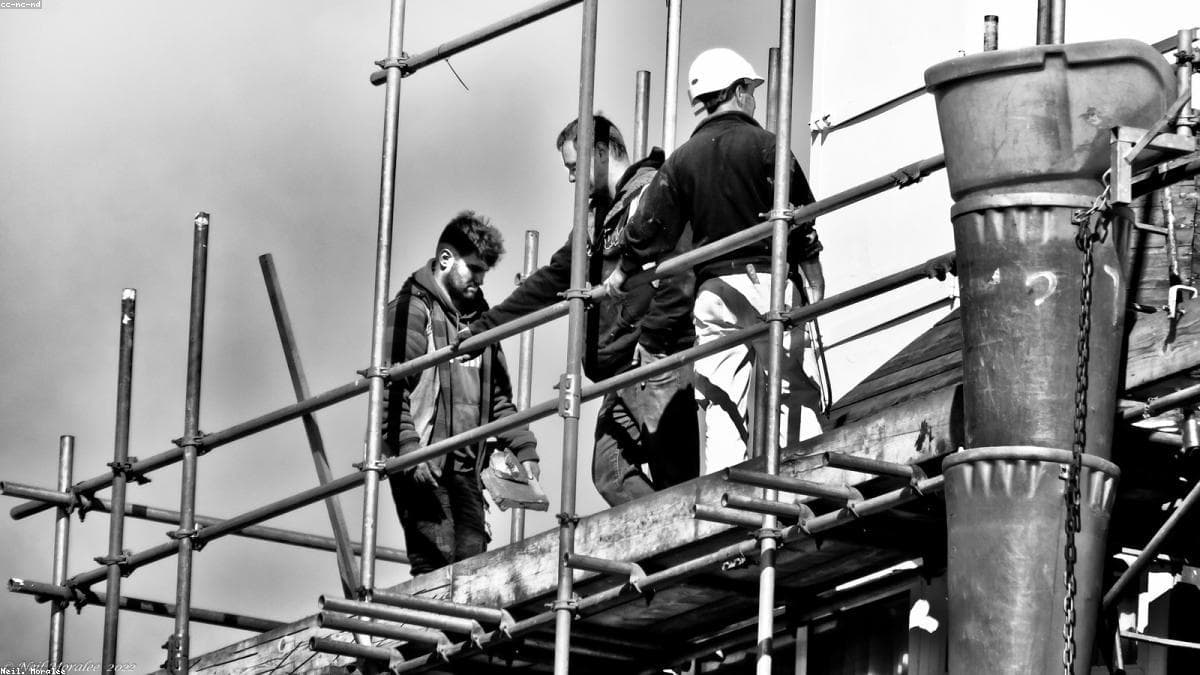
Work at Height VR training.
Rehearse harness use, anchor selection and fall-arrest procedure on virtual scaffolds and structures with real consequences, none of the risk.
Work at Height VR training
DrillXR Work at Height lets a trainee rehearse fall protection on virtual scaffolds and structures where the consequences are real but the risk is not. The simulation reproduces the hazards that drive height fatalities: falls from height, anchor points chosen or rated incorrectly, scaffold and ladder failure, and dropped objects that endanger anyone below. Inside the headset the worker inspects their PPE and harness, selects and rates a suitable anchor, connects and maintains one-hundred-percent tie-off as they move, works only within the safe envelope their lanyard allows, and finally descends and inspects their equipment. Because the learner physically reaches, clips and repositions, they build the discipline of staying attached rather than simply being told to.
Falls from height remain one of the leading causes of death on Indian work sites, and the legal framework reflects that. The Factories Act 1948 sets duties for safe work at height inside factory premises, BIS IS 3521 governs fall-arrest equipment, and the Building and Other Construction Workers Act extends protection across construction sites where so much height work happens. The most dangerous moment is the transition, the instant a worker unclips to move and is momentarily unprotected, and that is precisely the behaviour a poster cannot train out. DrillXR makes the unclipped fall happen in the headset, repeatedly and safely, so the habit of continuous attachment is built before a worker is ever exposed on a real structure.
Why train work at height in VR
Height training has a unique problem: you cannot safely let a trainee fall to teach them why tie-off matters, yet that visceral consequence is the whole lesson. VR resolves the contradiction. The trainee experiences the drop, the jolt of arrest, or the swing into a structure, with the full sense of exposure a headset's height perception creates, and walks away unhurt and instructed. They practise choosing a rated anchor over a convenient pipe, maintaining one-hundred-percent tie-off through a move, and keeping inside the safe envelope, all of which are judgement calls that classroom theory leaves abstract. Staging the same lesson on a real structure means putting a learner at genuine risk; DrillXR removes the risk while keeping the consequence, which is exactly why immersive practice changes behaviour where briefings do not.
Inside a work at height session
A session places the trainee at the base of a scaffold with a task to perform at elevation. They begin by inspecting their harness and lanyard, checking webbing, stitching and connectors; a damaged item flagged correctly earns credit, missed it costs. They select an anchor and must reject an unrated convenient point in favour of a certified one. Ascending, the worker connects and is required to maintain one-hundred-percent tie-off, using a twin lanyard to stay attached through each transition; unclip to move faster and a fall is triggered and scored. At height they work within the safe envelope, neither over-reaching nor leaving slack that would worsen a fall. They also secure tools against dropping. The run closes with a controlled descent and a post-use equipment inspection.
Scoring & certification
Each attempt is scored against the procedure: PPE and harness inspected, anchor selected and rated, connected with one-hundred-percent tie-off maintained, work kept within the safe envelope, and a controlled descent with inspection. The system logs the critical failures specifically, an unrated anchor, a tie-off break during a transition, an over-reach beyond the envelope, a dropped tool, so an instructor sees the exact lapse. Weighted per-step results produce an overall competency outcome, and a passing run issues a dated certificate against the worker's record. Data streams over xAPI and SCORM to the LMS and the DrillXR compliance dashboard, giving a safety lead auditable evidence of height competence and a clear list of who needs reassessment before their next permit.
Deployment on your site
Work at Height runs on Meta Quest, Pico and PC-VR and starts in kiosk mode, booting directly into the module so a site induction can run a queue of workers through without an instructor driving menus. The scenario is configurable to the customer's reality: scaffold and structure types, available anchor points, lanyard configuration and the height profile can be set to match the work actually performed on site. Headsets are managed as a fleet from a single console, with completion records feeding the central dashboard. For construction, power and infrastructure operators spread across many sites, this delivers identical height training and assessment wherever the work is, before anyone is cleared onto a real structure.
Explore all VR safety training, see how it adapts to your industry, or read whether VR is effective for safety training.
Hazards it reproduces
- falls from height
- incorrect anchor points
- scaffold/ladder failure
- dropped objects
The scored procedure
- 01Inspect PPE & harness
- 02Select and rate the anchor
- 03Connect and maintain 100% tie-off
- 04Work within the safe envelope
- 05Descend and inspect
Compliance mapping
Work at Height training by industry & location
Tuned to sector hazards and local regulation. Explore the combinations most relevant to this module.
Work at Height FAQs
What does the Work at Height VR module cover?
Rehearse harness use, anchor selection and fall-arrest procedure on virtual scaffolds and structures with real consequences, none of the risk.
Which hazards does it simulate?
falls from height; incorrect anchor points; scaffold/ladder failure; dropped objects.
Is the work at height training assessed?
Yes. Every step is scored and timed, with pass thresholds that trigger certificates and feed the compliance dashboard.
Which standards does it map to?
Factories Act 1948 (work at height); BIS IS 3521 (fall-arrest); BOCW Act (construction).
See Work at Height scored live.
Book a walkthrough tuned to your equipment and site.