
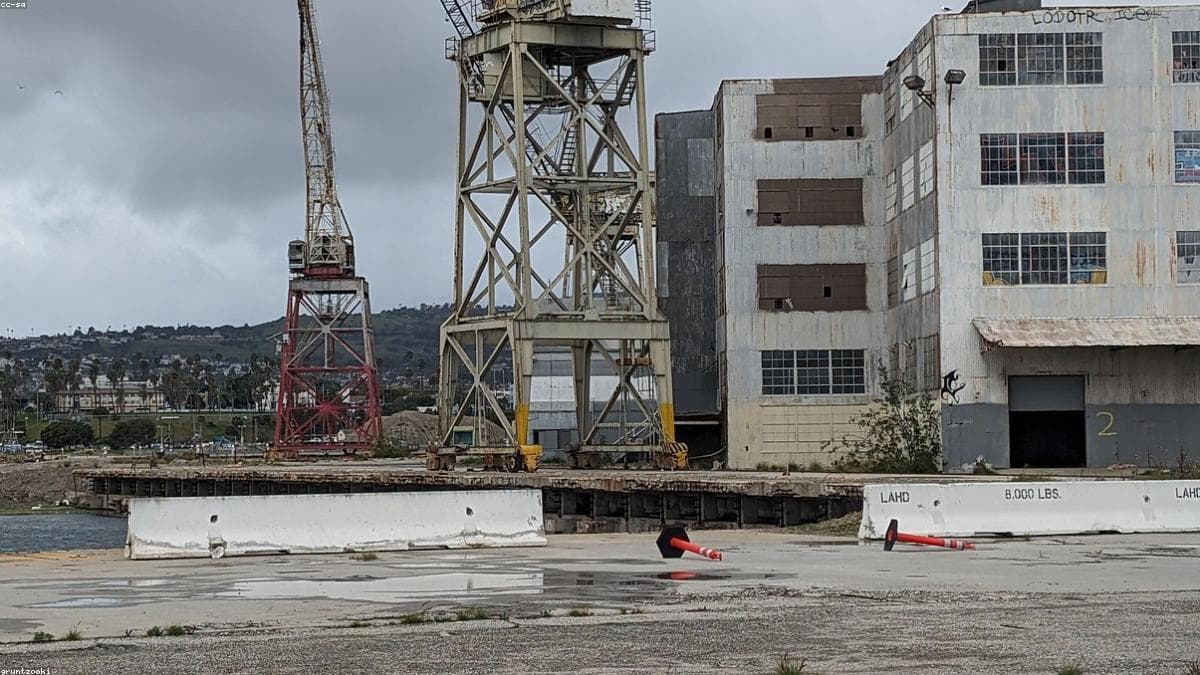
VR safety training for ports and dock workers in India.
Ports and maritime safety training that drills confined-space cargo holds, container and crane handling, and hazardous-cargo fire response in VR. Real incident data, Dock Workers Act-aligned, audit-ready competence.
operate under the Major Port Authorities Act and DGFASLI dock-safety oversight, each a dense concentration of heavy-lift and confined-space risk.
Source: Ministry of Ports, Shipping & Waterways / DGFASLI
The challenge: heavy lifts, dead air and hazardous cargo
India's 12 major ports handled a record 915.17 million tonnes of cargo in FY2025–26, and the work that moves it is unforgiving: containers swung overhead on ship-to-shore cranes, lashing and unlashing at height, and entries into ship holds, tanks and ballast spaces where the air can be lethal. On 1 August 2020, a crane being load-tested collapsed at Hindustan Shipyard in Visakhapatnam and killed 11 workers, most of them contract labour — a stark reminder that the heaviest gear fails worst when it fails.
The quieter killer is the enclosed space. The International Transport Workers' Federation has recorded 145 confined-space deaths over two decades, with 16 dockers and 12 seafarers dying since January 2018 from asphyxiation, explosion or collapse in oxygen-deficient cargo holds and fumigated spaces. Add hazardous cargo — the MV Wan Hai 503, carrying IMDG Class 3/4.1/4.2/6.1 materials bound for Mumbai, caught fire off the Indian coast in June 2025 with four crew lost — and the port becomes a stack of exactly the procedures you can never stage on a live berth.
in the 2020 Hindustan Shipyard (Visakhapatnam) crane collapse — most of them contract labour.
public reporting (Gulf News)
dead in enclosed-space incidents (asphyxiation, explosion, collapse) since January 2018.
International Transport Workers' Federation (ITF)
the statutory safety framework, with the 1990 Regulations, that major-port competence must satisfy.
Dock Workers (Safety, Health and Welfare) Act 1986 / DGFASLI
A safety briefing can describe an oxygen-deficient cargo hold, but it cannot make a docker test the atmosphere, refuse the entry and run a non-entry rescue under pressure — the exact sequence that decides whether the worker, or the rescuer who follows them in, comes back out.
The DrillXR approach for ports & maritime
DrillXR puts dock workers inside true-to-life port hazards in VR — confined-space entry into holds and tanks with live atmospheric testing and non-entry rescue, container and crane-handling discipline with load and exclusion-zone awareness, work at height for lashing, and hazardous-cargo fire response — and scores every action against the correct procedure. Crews rehearse the dead-air entry and the cargo fire safely, repeatedly, until the response is instinct.
Multiplayer emergency drills let a supervisor, entry team and rescue team rehearse a coordinated hold-rescue or cargo-fire response together, with communication and handoffs scored — not just individual steps. Every attempt maps to the Dock Workers (Safety, Health and Welfare) Act 1986 and its 1990 Regulations and lands in one audit-ready compliance record.
The case for immersive rehearsal, from published research
A landmark PwC study of immersive training found that VR learners completed training up to four times faster than in the classroom, were up to 275% more confident applying what they had learned, and felt 3.75 times more emotionally connected to the material than classroom learners — the emotional encoding that makes a procedure stick under real pressure.
The National Training Laboratories' learning research puts retention from learning-by-doing at roughly 75%, against only about 5% for a lecture and 10% for reading. Safety procedures are doing — not facts to memorise — which is exactly where immersive rehearsal compounds. The ILO, separately, estimates that workplace accidents and ill-health cost economies around 4% of GDP, so the upside of competence that actually transfers is measured in avoided incidents, not training hours.
faster to competency than classroom training (PwC benchmark, applied to your onboarding).
knowledge retention for rehearsed, hands-on procedures vs ~5% for lectures (NTL).
of attempts scored, timed and certified into one audit-ready record.
Projected impact based on published, third-party VR-training research (PwC; National Training Laboratories) applied to a DrillXR deployment — research-based benchmarks, not a guarantee or a specific client result. Your own figures are established during a pilot.
Every figure on this page is cited
The statistics above are drawn from public regulators, government data and independent research, not from DrillXR. Industry figures describe the sector’s real risk; the efficacy figures come from third-party VR-training studies. We do not publish invented client outcomes.
- [1]public reporting (Gulf News / Indian Coast Guard) — Hindustan Shipyard Visakhapatnam crane collapse (2020); MV Wan Hai 503 hazardous-cargo fire (2025).
- [2]International Transport Workers' Federation (ITF) — Confined-space dock and seafarer fatalities (145 over 20 years; 16 dockers since 2018).
- [3]PwC — The Effectiveness of VR Soft Skills Training in the Enterprise (study).
- [4]National Training Laboratories — Learning retention / the learning pyramid.
- [5]International Labour Organization (ILO) — The enormous burden of poor working conditions (≈4% of GDP).
Ports & Maritime VR training — FAQs
What VR safety training is most relevant to ports and dock work?
Confined-space entry into cargo holds and tanks, container/crane handling and machine safety, forklift and material handling, and work at height for lashing — plus multiplayer drills for coordinated hold-rescue and hazardous-cargo fire response.
Does it map to the Dock Workers Act and DGFASLI requirements?
Yes — every drill is scored, timed and certified, and the compliance dashboard produces audit-ready evidence aligned to the Dock Workers (Safety, Health and Welfare) Act 1986 and the 1990 Regulations enforced by DGFASLI.
Can it safely drill an oxygen-deficient cargo-hold entry?
That is precisely the point — VR recreates the dead-air hold with no real exposure, so workers rehearse atmospheric testing, entry refusal and non-entry rescue before any real entry, where most fatalities also claim the rescuer.
Prove competence in ports & maritime, before the incident.
Book a walkthrough tuned to your sector hazards, or scope a pilot on your own site.