
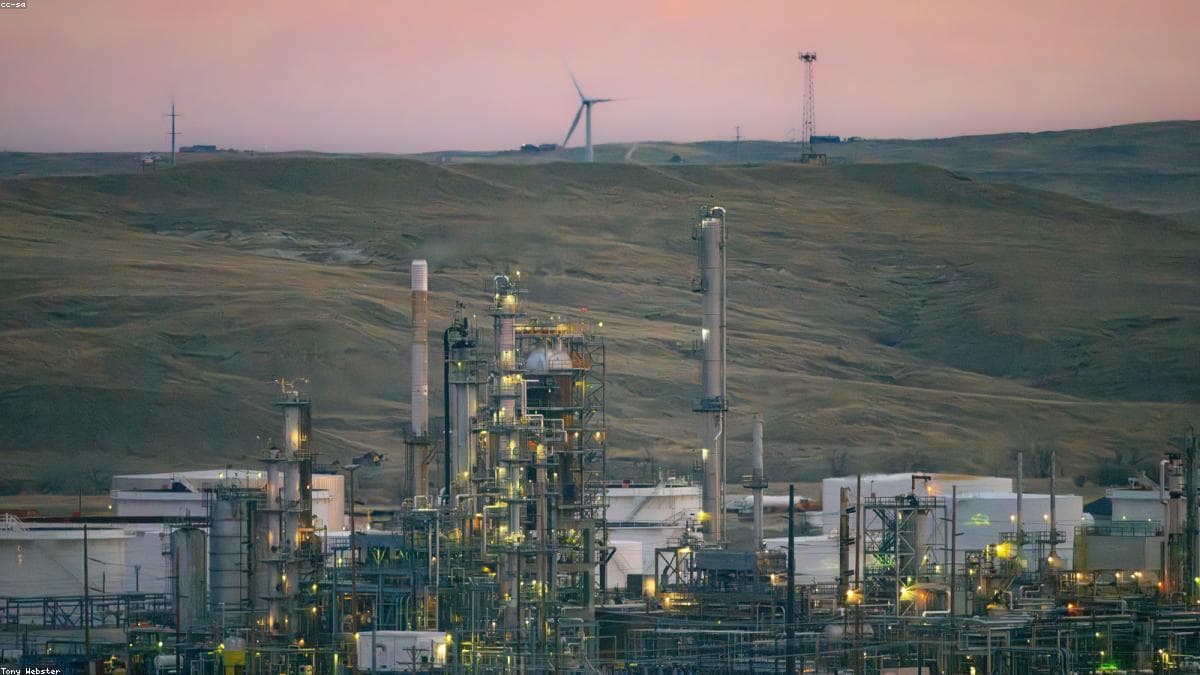
VR safety training for oil and gas in India.
How VR safety training cuts process-safety risk for India's refineries and oil & gas operations: real incident data, confined-space and fire drills, and audit-ready competence.
operate across India under OISD oversight — each a concentration of high-energy process-safety risk.
Source: Oil Industry Safety Directorate (OISD)
The challenge: process-safety events you can never stage
India's oil & gas sector — 19 public-sector and 4 private/JV refineries, plus terminals, pipelines and upstream fields — runs on procedures that fail catastrophically when they fail at all. The 2020 Baghjan blowout in Assam burned for months; the 2009 IOCL Jaipur depot fire levelled a terminal. These are low-frequency, maximum-consequence events: a hot-work permit skipped, a confined-space entry mis-sequenced, a gas release mis-handled.
The defining problem is that you cannot rehearse the worst case on a live plant. You cannot ignite a real fire, release real H2S, or stage a real confined-space rescue to find out who freezes. So the highest-stakes procedures are the ones operators have practised the least — exactly inverted from where competence is needed most.
the 2020 Baghjan (Oil India) blowout burned before it was capped.
public incident record
the statutory regulator whose process-safety standards refineries must evidence.
OISD
the economy-wide cost of workplace accidents and ill-health.
ILO
Toolbox talks and slide decks describe the emergency; they never make anyone perform it under time pressure. When a real release happens, muscle memory — not a remembered slide — decides the outcome, and classroom training simply does not build muscle memory.
The DrillXR approach for oil & gas
DrillXR puts operators inside true-to-life refinery hazards in VR — confined-space entry with live atmospheric testing, fire response with physics-driven spread, and chemical-release containment — and scores every action against the correct procedure. Crews repeat the worst day until the response is instinct, safely and at scale, then prove it.
Multiplayer emergency drills let an incident commander, first responders and a fire team rehearse a coordinated response together, with communication and handoffs scored — not just individual steps. Every attempt maps to OISD and Factories Act expectations and lands in one compliance dashboard.
The case for immersive rehearsal, from published research
A landmark PwC study of immersive training found that VR learners completed training up to four times faster than in the classroom, were up to 275% more confident applying what they had learned, and felt 3.75 times more emotionally connected to the material than classroom learners — the emotional encoding that makes a procedure stick under real pressure.
The National Training Laboratories' learning research puts retention from learning-by-doing at roughly 75%, against only about 5% for a lecture and 10% for reading. Safety procedures are doing — not facts to memorise — which is exactly where immersive rehearsal compounds. The ILO, separately, estimates that workplace accidents and ill-health cost economies around 4% of GDP, so the upside of competence that actually transfers is measured in avoided incidents, not training hours.
faster to competency than classroom training (PwC benchmark, applied to your onboarding).
knowledge retention for rehearsed, hands-on procedures vs ~5% for lectures (NTL).
of attempts scored, timed and certified into one audit-ready record.
Projected impact based on published, third-party VR-training research (PwC; National Training Laboratories) applied to a DrillXR deployment — research-based benchmarks, not a guarantee or a specific client result. Your own figures are established during a pilot.
Every figure on this page is cited
The statistics above are drawn from public regulators, government data and independent research, not from DrillXR. Industry figures describe the sector’s real risk; the efficacy figures come from third-party VR-training studies. We do not publish invented client outcomes.
- [1]Oil Industry Safety Directorate (OISD) — Process-safety case studies and standards.
- [2]public reporting — Baghjan blowout (2020) and Jaipur IOCL fire (2009) incident records.
- [3]PwC — The Effectiveness of VR Soft Skills Training in the Enterprise (study).
- [4]National Training Laboratories — Learning retention / the learning pyramid.
- [5]International Labour Organization (ILO) — The enormous burden of poor working conditions (≈4% of GDP).
Oil & Gas VR training — FAQs
What VR safety training is most relevant to oil & gas?
Confined-space entry, fire & emergency response, and chemical-spill/containment are the highest-value modules, plus multiplayer emergency mock drills for coordinated incident response.
Does it map to OISD requirements?
Yes — every drill is scored and certified, and the compliance dashboard produces audit-ready evidence aligned to OISD standards and the Factories Act 1948.
Can it run at a remote field or terminal?
Yes. Standalone headsets ship in kiosk mode and need no per-user setup, so drills run on-site at refineries, terminals and upstream locations.
Prove competence in oil & gas, before the incident.
Book a walkthrough tuned to your sector hazards, or scope a pilot on your own site.