
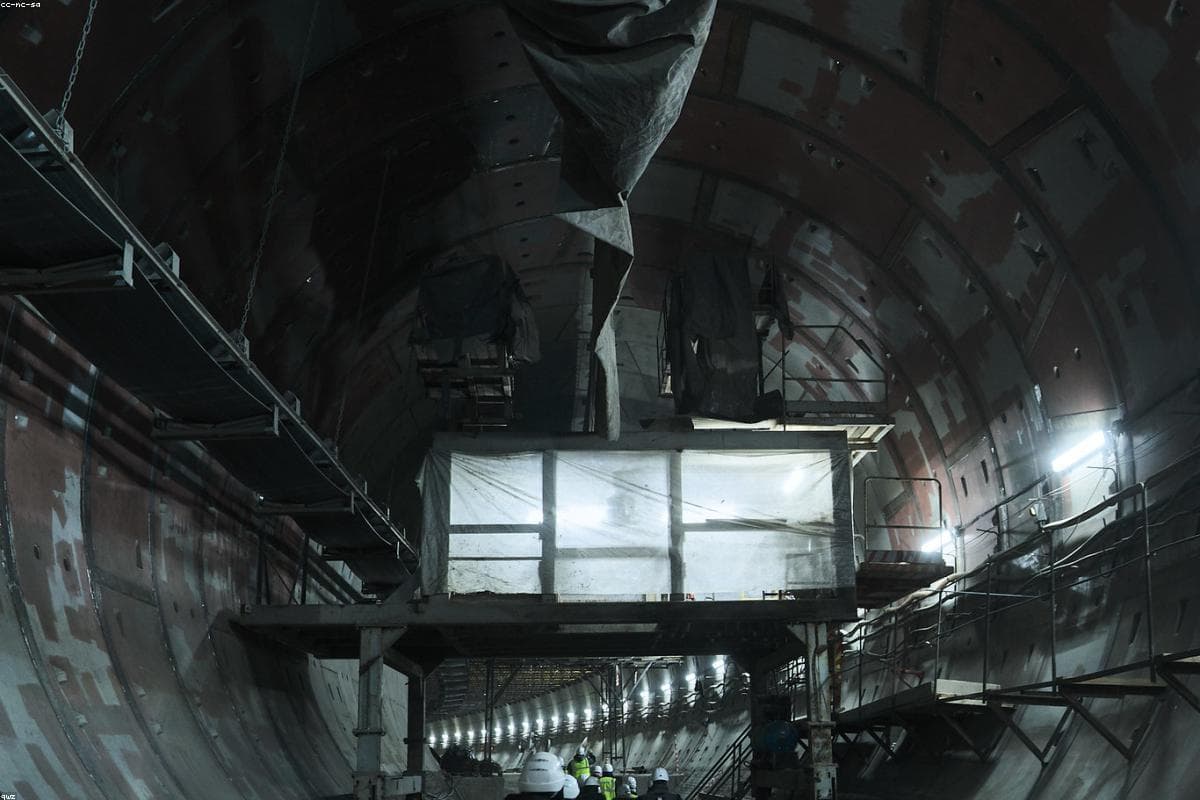
VR safety training for metro and tunnel construction in India.
Urban-infrastructure safety training that drills falls from viaducts, girder-launching and tunnel confined-space hazards in VR. Real incident data, BOCW-aligned, audit-ready competence.
when a 700-tonne launching girder collapsed during elevated-corridor construction at Shahapur, Thane (2023).
Source: Business Today / Free Press Journal
The challenge: working at height, over traffic, and deep underground
India is building metros in more than 20 cities at once, and the work is unforgiving in two directions. Above ground, crews erect elevated viaducts and launch girders weighing hundreds of tonnes over live arterial roads: in July 2023 a 700-tonne launching girder collapsed during Samruddhi-corridor viaduct construction at Shahapur in Thane and killed 17 workers, and in June 2025 two recently erected I-girders, each 50–100 tonnes, collapsed at a Chennai Metro Phase-2 site, killing a passer-by. Below ground, tunnel-boring runs through soft soil, high groundwater and hard granite — the exact conditions that delayed Namma Metro's tunnelling — into confined, oxygen-variable headings.
The hazard profile is therefore split: falls from viaduct and elevated works, girder-launching and lifting failures, and confined-space entry deep underground where escape is slow. The November 2023 Silkyara road-tunnel collapse in Uttarakhand, which trapped 41 workers for 17 days before a manual rat-hole rescue, is the reference case for how badly a tunnel heading can go wrong — and how little margin a trapped crew has.
workers in the 2023 Silkyara (Uttarakhand) tunnel collapse, freed only after 17 days.
NDRF / public record
by collapsing 50–100-tonne I-girders at a Chennai Metro Phase-2 site (2025).
CMRL / public reporting
the statutory framework metro and tunnelling deployments must satisfy.
BOCW Act 1996
A toolbox talk cannot replicate standing at an unguarded viaduct edge, sequencing a girder-launch lift, or entering a tunnel heading where the atmosphere is failing — the precise moments where a remembered slide is no substitute for a rehearsed, scored response.
The DrillXR approach for metro & tunnelling
DrillXR drills the split hazard profile in VR: work-at-height on viaducts and elevated decks with harness, anchor and fall-arrest discipline; machine and lifting safety for girder-launching and crane operations; and confined-space entry into tunnel headings with live atmospheric testing and non-entry rescue — scoring every action against the correct procedure. Crews rehearse the worst case before they reach the edge or the heading.
Multiplayer emergency mock drills let an incident commander, first responders and a rescue team rehearse a coordinated tunnel-entrapment or collapse response together, with communication and handoffs scored — not just individual steps. Every attempt maps to the BOCW Act 1996 and the Factories Act and lands in one audit-ready record, so competence is provable across a multi-city programme, not asserted site by site.
The case for immersive rehearsal, from published research
A landmark PwC study of immersive training found that VR learners completed training up to four times faster than in the classroom, were up to 275% more confident applying what they had learned, and felt 3.75 times more emotionally connected to the material than classroom learners — the emotional encoding that makes a procedure stick under real pressure.
The National Training Laboratories' learning research puts retention from learning-by-doing at roughly 75%, against only about 5% for a lecture and 10% for reading. Safety procedures are doing — not facts to memorise — which is exactly where immersive rehearsal compounds. The ILO, separately, estimates that workplace accidents and ill-health cost economies around 4% of GDP, so the upside of competence that actually transfers is measured in avoided incidents, not training hours.
faster to competency than classroom training (PwC benchmark, applied to your onboarding).
knowledge retention for rehearsed, hands-on procedures vs ~5% for lectures (NTL).
of attempts scored, timed and certified into one audit-ready record.
Projected impact based on published, third-party VR-training research (PwC; National Training Laboratories) applied to a DrillXR deployment — research-based benchmarks, not a guarantee or a specific client result. Your own figures are established during a pilot.
Every figure on this page is cited
The statistics above are drawn from public regulators, government data and independent research, not from DrillXR. Industry figures describe the sector’s real risk; the efficacy figures come from third-party VR-training studies. We do not publish invented client outcomes.
- [1]Business Today / Free Press Journal — Thane/Shahapur launching-girder collapse, 17 killed (2023).
- [2]NDRF / CMRL / public reporting — Silkyara tunnel collapse, 41 trapped (2023); Chennai Metro girder collapse (2025).
- [3]PwC — The Effectiveness of VR Soft Skills Training in the Enterprise (study).
- [4]National Training Laboratories — Learning retention / the learning pyramid.
- [5]International Labour Organization (ILO) — The enormous burden of poor working conditions (≈4% of GDP).
Metro & Tunnelling VR training — FAQs
Which modules matter most for metro and tunnel construction?
Work at height for viaducts and elevated works, machine and lifting safety for girder-launching, and confined-space entry for tunnel headings — plus multiplayer mock drills for coordinated tunnel-entrapment response.
Can it drill a tunnel collapse or entrapment safely?
Yes — that is the point. VR recreates confined-space tunnel hazards and entrapment scenarios with no real risk, so the response is rehearsed before any real event like Silkyara.
Does it support BOCW and a multi-city programme?
Yes. Scored, certified drills produce audit-ready competency evidence aligned to the BOCW Act 1996 and the Factories Act, with one consistent record across every city and contractor.
Prove competence in metro & tunnelling, before the incident.
Book a walkthrough tuned to your sector hazards, or scope a pilot on your own site.